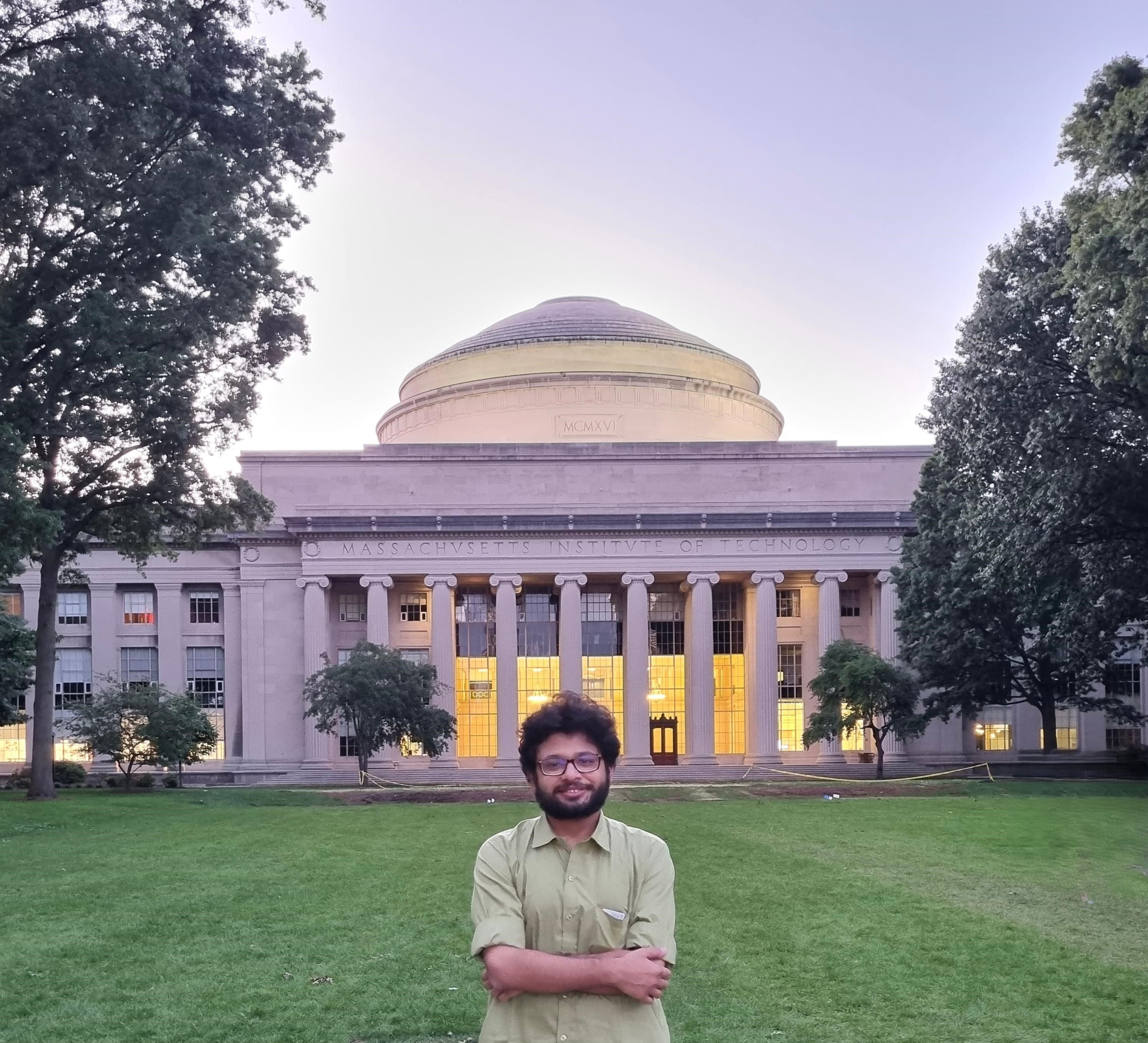
Google Developer Group - IIT M event
Date:
A guest talk on Causal Machine Learning, organized by Kalyani Vijay Pakhale through the Google Developer Group of IIT Madras.
You can find the slides here
Abstract: Causal AI is an approach in artificial intelligence that constructs causal models, allowing systems to reason based on cause-and-effect rather than mere correlations. The importance of this concept—and the limitations of traditional machine learning—were highlighted by Turing Award-winning scientist and philosopher Judea Pearl in his 2018 book The Book of Why: The New Science of Cause and Effect. Pearl argued that “machines’ lack of understanding of causal relations is perhaps the biggest roadblock to giving them human-level intelligence.” A 2024 paper from Google DeepMind further supported this view, mathematically demonstrating that “any agent capable of adapting to a sufficiently large set of distributional shifts must have learned a causal model.” The authors interpret this to mean that generalizing beyond the training data requires learning a causal structure, ultimately concluding that causal AI is essential for achieving artificial general intelligence (AGI).
This is one of my current areas of research. Initially, I approached it purely from a technical perspective. Personally, I’ve come to realize that progress in this “notoriously difficult and endlessly interesting” concept necessitates taking a step back to look beyond and explore how it has been studied in other fields. My first introduction to this was when my roomate was going through, in his words, “Wald’s incredibly hard textbook in General Relativity” as a part of his summer project. Infact surprisingly, apart from Statistics & Mathematics, it has a significant appearance and treatise in Philosophy (for instance by Aristotle, Francis Bacon and David Hume etc.), Physics (in Einstein’s Theory of relativity and Quantum Mechanics), Hindu mythology (in the Bhagavad Gita and Sanatana Dharma ).